Best Crypto Domain Services
Best Crypto Domain Services for Decentralized Hosting
The internet is undergoing a fundamental shift in how data is stored, shared, and owned. For decades, the Domain Name System (DNS) has acted as the phonebook of the web, translating human-readable names like google.com into machine-readable IP addresses. However, this traditional system relies on centralized authorities like ICANN and commercial registrars who have the power to seize, censor, or revoke domains at will.
Crypto domains, often referred to as Web3 or blockchain domains, offer a decentralized alternative. These domains are not mere entries in a database held by a corporation; they are unique digital assets stored on a blockchain. This shift allows for decentralized hosting, where a website’s files are distributed across a peer-to-peer network rather than sitting on a single company’s server.
Decentralized hosting matters because it provides a foundation for a truly open internet. It removes single points of failure and prevents arbitrary shutdowns by third parties. While traditional domains are essentially “leased” through annual fees, crypto domains emphasize true ownership, censorship resistance, and a unified Web3 identity. This article explores the technology behind these domains and reviews the five best services leading the charge toward a decentralized web.
Read: Coca Cola: What Can We Learn From the World’s Most Recognizable Brand?
What Are Crypto Domains?
A crypto domain is a naming system built on top of a blockchain, such as Ethereum or Polygon. Unlike traditional domains that are managed by a central registry, crypto domains are typically issued as Non-Fungible Tokens (NFTs). This means that when you register a name, the record of your ownership is etched into a public ledger, giving you full control over the asset without the need for a middleman.
Definition of Blockchain-Based Domains
At its core, a blockchain domain is a smart contract address with a human-readable alias. In the traditional world, if you want to visit a website, your request goes through a series of servers that can be blocked or redirected. In the blockchain world, the domain resolution happens on a distributed ledger. Because the “registry” is the blockchain itself, it is public, immutable, and accessible to anyone with an internet connection.
How They Are Stored
Ownership of a crypto domain is proven by holding a specific NFT in a digital wallet. This is a massive departure from the legacy system. In the traditional DNS, you are a “registrant,” essentially a tenant paying rent to a landlord (the registrar). If you stop paying or violate a terms-of-service agreement, the landlord can evict you. With a crypto domain, you are the absolute owner. As long as you have the private keys to your wallet, the domain belongs to you. It can be bought, sold, or traded on secondary marketplaces just like a piece of digital art or a virtual plot of land.
How They Differ from DNS
The traditional DNS operates on a hierarchical structure where various root servers and registrars manage the flow of information. If a registrar decides to take your site down, or if a government issues a court order, your domain can disappear.
Blockchain domains operate on a decentralized ledger. There is no central “off switch.” Once a domain is minted into your private wallet, you are the only person who can transfer, sell, or modify its records. You don’t rent these domains in the traditional sense; you own them as digital property. Furthermore, traditional domains require personal information (Whois data) that is often harvested by spammers; crypto domains allow for much greater privacy, as ownership is linked to a wallet address rather than a physical identity.
Use Cases: Wallet Addresses, Websites, and Identity
-
Crypto Wallets: Instead of sharing a complex, 42-character hexadecimal string like
0x71C..., you can simply tell someone to send funds toyourname.eth. This significantly reduces the risk of errors and makes the user experience feel more like traditional banking or Venmo. -
Decentralized Websites: By linking a domain to a decentralized storage protocol, you can host websites that are virtually impossible to take down. These sites do not live on a server in a data center but are spread across the globe.
-
Identity in Web3: These domains serve as a single username across various decentralized applications (dApps), social media platforms, and metaverse environments. When you connect your wallet to a dApp, your domain name and profile picture can follow you, creating a consistent persona.
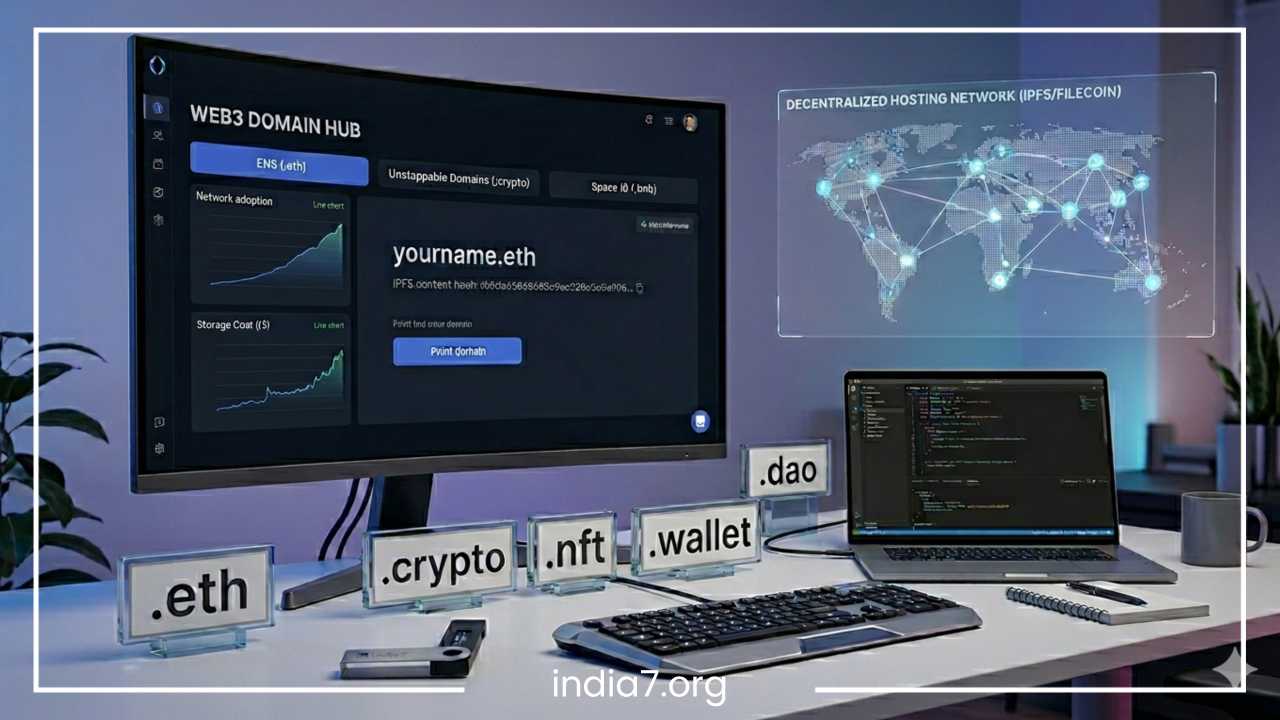
Common domain extensions in this space include .eth, .crypto, .nft, .dao, and .wallet.
Read: Big Brands Averting a PR Disaster
How Decentralized Hosting Works
To understand the value of a crypto domain, one must understand the infrastructure that supports it. Traditional hosting relies on “The Cloud,” which is often just a collection of massive servers owned by companies like Amazon, Google, or Microsoft. Decentralized hosting replaces these central hubs with distributed protocols.
What Decentralized Hosting Means
In a decentralized hosting environment, a website’s files are broken into pieces, encrypted, and stored across a network of independent computers (nodes). When a user wants to view the site, the pieces are gathered from the nearest or fastest nodes and reassembled in the browser. This means there is no single point of failure. If one node goes offline, the data is still available from hundreds of others.
Storage Systems: IPFS, Filecoin, and Arweave
Instead of a single server, decentralized websites use peer-to-peer file-sharing systems. The most prominent include:
-
IPFS (InterPlanetary File System): This is a protocol and peer-to-peer network for storing and sharing data. It uses “content-addressing” to uniquely identify each file based on its content rather than its location. If the content changes, the address changes, ensuring that you are always viewing exactly what the creator intended.
-
Filecoin: Often described as an incentive layer for IPFS, Filecoin allows users to pay nodes to ensure their data is stored reliably and remains accessible over time. It creates a competitive marketplace for storage, often at a fraction of the cost of traditional cloud providers.
-
Arweave: This protocol focuses on “permaweb” storage. By paying a one-time fee, users can store data that is intended to last for centuries. It uses a unique “blockweave” structure to ensure that data is never lost, making it ideal for permanent decentralized websites and historical archives.
How Domains Connect to Hosted Content
When you visit a traditional website, your browser asks a DNS server for an IP address. In the decentralized world, your browser (or a specialized extension) looks at the blockchain to find the “Content Hash” associated with your crypto domain. This hash (a long string of characters) points to a specific set of files on IPFS or Arweave. The browser then pulls those files from various nodes across the globe to render the site.
Advantages: Resilience and Permanence
The transition to decentralized hosting offers several technical and philosophical benefits:
-
No Central Server: There is no “master computer” to crash, be hacked, or be shut down by a provider.
-
Resistant to Shutdowns: Because the files are distributed across thousands of independent nodes, no single entity can “delete” the website. This is a major win for free speech and information access.
-
Permanent Storage: Systems like Arweave ensure that historical data and culture are preserved without the risk of “link rot” or domain expiration.
Read: The Secret Power of Your Brand Logo: Design for Impact & Recognition
Key Features to Look for in Crypto Domain Services
Choosing a domain provider is a long-term decision. Before committing to a service, you should evaluate them based on the following criteria:
-
Supported Blockchain Networks: Does the service run on Ethereum, Polygon, Solana, or a proprietary chain? This affects transaction costs (gas fees) and the number of dApps that recognize the domain. Ethereum domains have the most “prestige” but higher costs, while Polygon domains are much cheaper to manage.
-
Domain Extensions Offered: Some users prefer the classic
.eth, while others might want something more specific to their industry like.art,.go, or.biz. -
Decentralized Website Hosting Support: Not all domain services make it easy to link to IPFS. Look for platforms with built-in tools or “one-click” hosting integrations.
-
Wallet Integration Compatibility: A domain is only useful if other people’s wallets can find it. The most established services have the widest integration across MetaMask, Trust Wallet, and Ledger.
-
Ease of Use (UI/UX): Some services require technical knowledge of smart contracts, while others provide a “shopping cart” experience similar to GoDaddy.
-
Pricing Model: This is a major differentiator. Some services require annual renewal fees (like ENS), while others offer a “buy once, own forever” model (like Unstoppable Domains).
-
Security and Ownership Control: Check if the service is truly decentralized or if the company maintains some “master key” over the registry.
-
NFT Transferability: Since these domains are NFTs, you should be able to list them on secondary marketplaces like OpenSea or Rarible easily.
-
Integration with Browsers: Check if the domain works natively in Brave or Opera, or if it requires a plugin.
The 5 Best Crypto Domain Services
Ethereum Name Service (ENS)
The Ethereum Name Service (ENS) is the oldest and most widely adopted naming system in the Web3 space. It manages the popular .eth extension and operates as a decentralized autonomous organization (DAO). Since its inception, ENS has become the de facto standard for crypto identity.
ENS is deeply integrated into the Ethereum ecosystem. Almost every major wallet, DeFi platform, and NFT marketplace supports ENS. Because it is built on the Ethereum mainnet, it benefits from the highest level of security and decentralization. However, this also means that users are subject to Ethereum’s gas fees, which can be high during periods of network congestion.
One unique aspect of ENS is its renewal model. Users must pay an annual fee (typically around $5 USD for names with 5+ characters) to maintain ownership. This is intended to prevent “domain squatting”—the practice of buying up thousands of names and sitting on them to extort future buyers. The fees collected go to the ENS DAO treasury to fund further development of the ecosystem.
Pros:
-
Most widely supported across wallets and dApps.
-
Highly secure and decentralized.
-
Strong secondary market value for short or dictionary-word names.
-
Supports traditional DNS imports (e.g., you can link a .com to an ENS record).
Cons:
-
Requires annual renewal fees.
-
Gas fees for registration and management can be expensive.
Unstoppable Domains
Unstoppable Domains is the primary competitor to ENS and takes a very different approach to ownership. They offer a variety of extensions including .crypto, .nft, .wallet, .x, and .polygon. Their primary selling point is simplicity: there are no renewal fees. Once you buy a domain, it is yours forever.
The service is built primarily on the Polygon network (a Layer-2 scaling solution for Ethereum), which means that managing your domain—such as updating your IPFS website link or adding a new wallet address—is usually free of gas fees. This makes it an incredibly attractive option for beginners and those looking to host decentralized websites without ongoing costs.
Unstoppable Domains also focuses heavily on the “Identity” aspect of Web3. They offer features like “Verified Profiles” and the ability to use your domain as a decentralized email address. Their interface is designed to be as user-friendly as possible, mimicking the experience of traditional web registrars.
Pros:
-
No renewal fees; true lifetime ownership.
-
Zero gas fees for updates on the Polygon network.
-
Extremely user-friendly interface.
-
Strong focus on Web3 identity and profile building.
Cons:
-
Slightly less integrated with legacy dApps compared to ENS.
-
The project started with a more centralized approach, though it is moving toward more decentralization.
Freename
Freename is a multi-chain domain platform that introduces a revolutionary concept to the naming space: the ability to create and own your own Top-Level Domains (TLDs). While ENS gives you a sub-domain of .eth, Freename allows you to own the entire extension, such as .yourbrand or .community.
This platform supports several blockchains, including Aurora, Binance Smart Chain (BSC), and Polygon. The most compelling feature of Freename is the passive income potential. If you own a TLD, you essentially act as the registrar for that extension. Every time someone else registers a name under your TLD (e.g., john.yourbrand), you receive a percentage of the registration fee.
This makes Freename a powerful tool for businesses, influencers, and communities looking to build their own mini-ecosystems. It moves the domain name from a personal asset to a business asset.
Pros:
-
Ability to create and own custom TLDs.
-
Passive income opportunities through TLD royalties.
-
Multi-chain support gives users flexibility in where they host their identity.
-
Strong branding focus for companies entering Web3.
Cons:
-
Newer platform with a smaller ecosystem than ENS or Unstoppable.
-
The market for custom TLDs is still experimental and may face fragmentation.
Handshake
Handshake is a decentralized naming and certificate authority that aims to replace the “root zone” of the internet. While other services focus on being an “alternative” to DNS, Handshake wants to be the foundation. It is its own dedicated blockchain (HNS) specifically designed for naming.
Handshake is highly technical and favored by decentralization purists. It operates on a system of Vickrey auctions where users bid on TLDs. Once you win a TLD, you have total control over it. You can use it to create your own websites, or you can even act as your own registrar and sell sub-domains to others.
Because Handshake is its own blockchain, it is not beholden to the rules of Ethereum or any other smart contract platform. It is a true experiment in internet sovereignty. However, its adoption among average users is lower due to the technical barriers to entry and the need for specialized browser configurations or extensions to view Handshake sites.
Pros:
-
Highest level of technical decentralization and sovereignty.
-
Allows for true “root” ownership of the naming system.
-
No central company or DAO governing the protocol.
-
Encourages a completely parallel internet infrastructure.
Cons:
-
Steep learning curve for setup and management.
-
Lower browser and wallet support compared to other services.
-
Requires the use of HNS coins for auctions and maintenance.
Space ID
Space ID is a universal name service network that aims to connect various blockchains through a single platform. It gained significant traction through its integration with the BNB Chain ecosystem (formerly Binance Smart Chain) and its .bnb domains, and has since expanded to Arbitrum ( .arb) and Sei ( .sei).
Space ID is building a “Web3 Name SDK” that allows developers to integrate multiple domain services into their apps easily. For users, it offers a “one-stop-shop” dashboard where they can manage all their different domains regardless of which chain they are on.
The platform also includes a robust marketplace for trading domains and a simplified dashboard for managing decentralized hosting records. For users who live primarily in the BNB or Arbitrum ecosystems, Space ID offers the most seamless experience for managing multi-chain identities.
Pros:
-
Excellent integration with the BNB Chain and Arbitrum ecosystems.
-
Aggregated platform for managing multi-chain identities.
-
Growing ecosystem with high developer activity and grants.
-
Simplified marketplace for buying and selling domains.
Cons:
-
Renewal fees are required for most extensions.
-
Heavily reliant on the growth of the specific chains it supports.
Comparison Table
| Service | Pricing Model | Primary Blockchain | Ease of Use | Hosting Support | Ideal For |
| ENS | Annual Renewal | Ethereum | Moderate | IPFS / Arweave | Power Users |
| Unstoppable | One-time | Polygon / Eth | High | IPFS / Swarm | Beginners |
| Freename | One-time | Multi-chain | High | IPFS | Brands / Earners |
| Handshake | Auction / Fee | Handshake (HNS) | Low | Various | Developers |
| Space ID | Annual Renewal | BNB / Arbitrum | Moderate | IPFS | Multi-chain Users |
Use Cases of Crypto Domains
The utility of a crypto domain extends far beyond just having a “cool name.” As the Web3 landscape matures, these domains are becoming essential tools for digital life.
Web3 Websites
By combining a crypto domain with IPFS or Arweave, you can launch a website that exists outside the control of traditional hosting providers. This is particularly useful for activists, journalists, and developers of decentralized finance (DeFi) protocols who need their interfaces to remain accessible regardless of regional restrictions or corporate censorship.
Crypto Payments
The most common use case is replacing long wallet addresses. By mapping your domain to multiple crypto addresses (BTC, ETH, SOL, etc.), you can receive various assets using a single name. This reduces the risk of “copy-paste” errors and makes crypto transactions feel more like sending an email. It humanizes the blockchain experience.
Decentralized Identity (DID)
In the future, your crypto domain may hold your verified credentials, such as your education history, proof of personhood, or membership in a DAO. Instead of logging into websites with a “Sign in with Google” button—which gives a corporation access to your data—you “Sign in with Ethereum” (or your chosen domain), maintaining total control over your information.
NFT Portfolios and Branding
Artists and collectors use domains to showcase their NFT portfolios. A domain like artistname.nft can serve as a professional gallery that is owned and controlled by the artist. For personal branding, having a consistent handle across all Web3 platforms is becoming as important as having a Twitter handle or Instagram name.
Advantages and Limitations
While crypto domains represent a massive leap forward, they are not without their hurdles.
Advantages
-
True Ownership: You hold the keys; no one can take your name away.
-
Censorship Resistance: Ideal for hosting sensitive content that must remain public.
-
Unified Identity: One name for all your wallets, dApps, and social profiles.
-
Asset Value: Rare names can be sold for significant sums on secondary markets.
Limitations
-
Browser Support: Most traditional browsers (Chrome, Safari) require extensions to view decentralized websites natively.
-
Learning Curve: Managing a domain involves understanding gas fees, seed phrases, and IPFS hashes.
-
Irreversibility: If you lose the private keys to the wallet holding your domain, it is gone forever. There is no “forgot password” link.
-
Adoption: While growing, the majority of the world still relies on the legacy DNS.
How to Choose the Right Crypto Domain Service
The “best” service depends entirely on your specific goals and technical comfort level.
-
For Beginners: Unstoppable Domains is often the best choice. The one-time payment means you don’t have to worry about losing your domain because you forgot to pay a bill, and the gas-free management on Polygon is very forgiving for those just starting out.
-
For Web3 Power Users: ENS is the gold standard. If you want maximum compatibility with every dApp, DeFi protocol, and NFT platform, a .eth name is a necessity. It is the most “recognized” identity in the space.
-
For Developers and Purists: Handshake offers a level of sovereignty that other platforms cannot match. If you want to experiment with the future of the internet’s root zone, Handshake is the place to be.
-
For Brands and Entrepreneurs: Freename offers the unique ability to own a TLD, allowing you to build a brand ecosystem and potentially earn revenue from others using your extension. It is the best choice for those thinking about Web3 as a business platform.
Future of Crypto Domains and Decentralized Hosting
The trajectory of crypto domains suggests they will eventually become the “Single Sign-On” (SSO) for the entire internet. We are already seeing the emergence of hybrid models where traditional DNS names can be linked to blockchain records, bridging the gap between the old web and the new.
As decentralized storage solutions like Arweave and Filecoin become faster and cheaper, the performance gap between centralized and decentralized hosting will close. We can expect browsers to eventually integrate blockchain resolution natively, removing the need for third-party extensions. Furthermore, the integration of Artificial Intelligence could allow for “smart domains” that can automatically manage their own hosting, update their content based on user interaction, or even interact with other smart contracts independently.
The shift toward a decentralized internet is not just a technical upgrade; it is a movement toward a more resilient, private, and user-owned digital world. By securing a crypto domain today, you are staking a claim in that future.
Final Thoughts
Crypto domains and decentralized hosting are the twin pillars of a freer internet. By moving naming and storage to the blockchain, users can finally claim true ownership of their digital presence. Whether you choose the massive ecosystem of ENS, the convenience of Unstoppable Domains, or the technical freedom of Handshake, the act of registering a crypto domain is your first step into the world of Web3.
As the ecosystem continues to grow, the importance of securing your digital identity will only increase. By understanding the features, costs, and storage protocols associated with these five services, you can make an informed decision and ensure your slice of the decentralized web is secure, accessible, and truly yours. The decentralized web is no longer a distant dream—it is being built, one domain at a time.
Frequently Asked Questions
What is the best crypto domain extension for SEO?
Currently, search engines like Google are still evolving in how they index blockchain domains. However, .eth and .crypto are the most recognized extensions in the industry. For decentralized search engines and Web3-native browsers, .crypto (from Unstoppable Domains) and .eth (from ENS) have the strongest integration, making them the most reliable choices for ensuring your decentralized site is discoverable.
Can I buy a crypto domain without renewal fees?
Yes. If you want to avoid recurring costs, Unstoppable Domains and Freename are the top choices. These services use a “buy once, own forever” model. Unlike the traditional DNS or the Ethereum Name Service (ENS), which require annual registration fees, these platforms mint the domain as an NFT directly into your wallet, giving you permanent ownership with no expiration date.
How do I host a website on a blockchain domain?
To host a decentralized website, you need two things: a crypto domain and decentralized storage like IPFS or Arweave. First, you upload your website files to IPFS to receive a “CID” (Content Identifier). Then, you access your domain management dashboard (on ENS or Unstoppable Domains) and paste that CID into the “Content” or “IPFS” field of your domain’s records. Once the blockchain transaction is confirmed, your domain will point to your decentralized files.
Do crypto domains work in normal browsers like Chrome or Safari?
Standard browsers do not natively resolve blockchain domains without assistance. To view a .eth or .crypto site in Chrome or Safari, users typically need to install a browser extension like MetaMask or Unstoppable Extension. However, Web3-native browsers like Brave and Opera have built-in support, allowing you to type a crypto domain directly into the URL bar just like a .com address.
Are crypto domains safe from government censorship?
Because crypto domains are stored on decentralized blockchains, they are significantly more resistant to censorship than traditional domains. There is no central authority (like ICANN) that can “seize” or “delete” a domain in your private wallet. While a government can still block access to a domain at the ISP level or through centralized browser gateways, the actual ownership and the files hosted on IPFS remain intact and accessible to anyone using decentralized tools.
What is the difference between ENS and Unstoppable Domains?
The primary difference lies in the blockchain and pricing. ENS is built on Ethereum and requires annual renewal fees. It is the most “official” identity for the Ethereum ecosystem. Unstoppable Domains is primarily used on Polygon, offers lifetime ownership with no fees, and provides a wider variety of extensions like .nft, .wallet, and .x.
Can I sell my crypto domain later?
Yes, crypto domains are NFTs (Non-Fungible Tokens). This means they can be listed and sold on secondary marketplaces such as OpenSea, Blur, or Rarible. Because you have total ownership, you can transfer the domain to any other wallet address in exchange for cryptocurrency, often potentially at a profit if you own a highly desirable or short name.