Best Free Ways to Track Expenses

Best Free Ways to Track Expenses: Simple and Effective Methods
Managing personal finances often feels like trying to solve a puzzle with missing pieces. For many individuals, the end of the month brings a familiar sense of confusion: the bank balance is lower than expected, yet there are no major purchases to account for the deficit. This “financial fog” is a primary source of stress, leading to missed savings goals and a constant cycle of living paycheck to paycheck. The reality is that most people do not have a problem with their income; they have a problem with their awareness.
Expense tracking is the foundational habit of financial literacy. It is the process of recording every dollar that leaves your pocket, providing a clear map of your financial habits. By shedding light on where your money actually goes, you regain control over your future. Whether you are looking to pay off debt, save for a dream vacation, or simply reduce the anxiety associated with opening your banking app, tracking is the first step.
Read: How to Negotiate Debt with Your Credit Card Company
The good news is that you do not need expensive software or a degree in accounting to master your money. There are numerous free, simple, and highly effective methods available to everyone. This article explores the best zero-cost strategies to track your spending, helping you find a system that fits your lifestyle and keeps your financial goals within reach.
Why Tracking Expenses Is Important
The primary benefit of expense tracking is the identification of “spending leaks.” These are the small, repetitive costs—such as unused subscriptions, daily gourmet coffees, or impulse convenience store purchases—that seem insignificant in isolation but aggregate into hundreds of dollars over a year. When you track every expense, these leaks become visible, allowing you to plug them and redirect those funds toward something more meaningful.
Furthermore, tracking improves budgeting accuracy. Most people set budgets based on what they think they spend. However, without data, these budgets are merely guesses. Tracking provides the hard evidence needed to create a realistic budget that you can actually stick to. It transforms budgeting from a restrictive exercise into a strategic tool for growth.
Beyond the numbers, tracking supports your long-term financial goals. Whether you are focused on aggressive debt payoff, building an emergency fund, or investing for retirement, you cannot optimize what you do not measure. By seeing your progress in black and white, you stay motivated. It also builds better money habits by creating a “pause” between the urge to spend and the act of spending. When you know you have to record a purchase, you are more likely to ask yourself if it is truly necessary.
Consider the “Small Expense Trap”: A $5 daily snack might feel trivial. However, over a month, that is $150. Over a year, it is $1,800. Tracking doesn’t mean you can never have that snack; it simply ensures that you are making a conscious choice rather than spending by default.
Read: Benefits of Online Payday Loans
Key Features to Look for in a Free Expense Tracker
When choosing a free method to track your expenses, it is easy to get overwhelmed by options. To ensure long-term success, your chosen system should possess several key characteristics:
-
Ease of Use: If a system is too complex or requires a steep learning curve, you will likely abandon it within two weeks. The best tracker is the one you actually use. Look for an interface or a process that feels intuitive.
-
Accessibility: Your tracker should be available when you are spending. If you only track at your desktop but spend money mostly while out, you might forget half of your transactions. Mobile accessibility or a portable manual method is crucial.
-
Automation vs. Manual Entry: Consider how much work you want to do. Automation (syncing with banks) saves time but can lead to a “set it and forget it” mentality where you lose touch with your spending. Manual entry takes more time but forces a higher level of mindfulness.
-
Security and Privacy: Especially with digital tools, ensure your data is protected. If using an app, check their privacy policy regarding how they handle your financial data.
-
Reporting and Insights: A list of numbers is helpful, but visual aids like charts and categorized summaries are better. Good trackers help you see trends over time, such as whether your grocery bill is rising month over month.
-
Customization: No two financial lives are identical. Your tracker should allow you to create categories that make sense for your specific life, whether that includes “Pet Care,” “Hobby Supplies,” or “Business Travel.”
Read: Invoice Financing for Business Cash Flow
Best Free Ways to Track Expenses
There is no “one size fits all” solution for financial tracking. The following methods range from high-tech automation to traditional pen-and-paper, each offering unique benefits depending on your personal preferences.
1. Spreadsheet Method (Excel / Google Sheets)
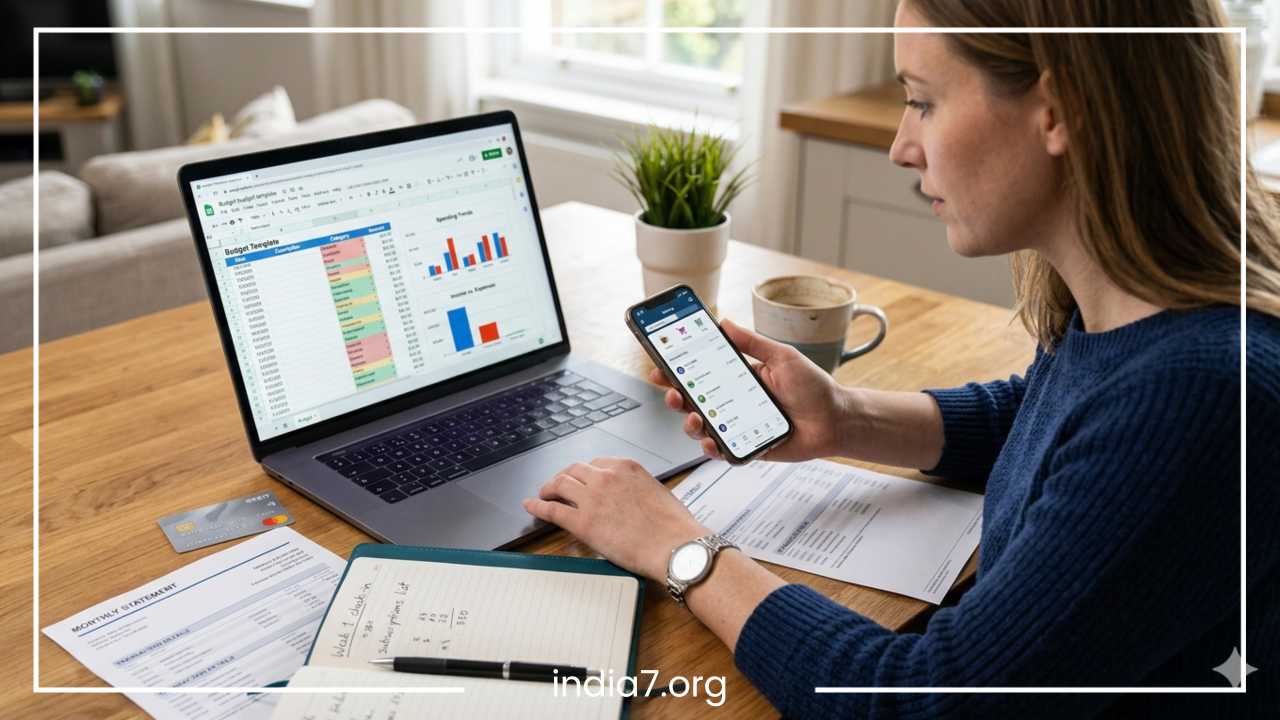
For those who love data and total control, the spreadsheet is the gold standard. Using free tools like Google Sheets or the web version of Microsoft Excel, you can build a completely custom tracking universe.
-
How it works: You create columns for the date, description, category, and amount. At the end of each day or week, you input your transactions from your receipts or bank statements.
-
Pros: It is infinitely customizable. You can create complex formulas to calculate your savings rate or project future wealth. It is free and accessible across devices if stored in the cloud.
-
Cons: It requires a high level of manual effort and a basic understanding of spreadsheet software. It can be tedious to enter every single line item if you have a high volume of transactions.
-
Best for: Organized users who enjoy analyzing data and want a historical record they can keep forever without relying on a third-party app’s existence.
-
Tips: Don’t start from scratch. Use the “Annual Financial Budget” templates built into Google Sheets. Set aside 10 minutes every Sunday to update it so the task never becomes overwhelming.
2. Free Expense Tracking Apps
In the age of smartphones, dedicated apps are the most popular way to stay on top of finances. Many apps offer a robust free tier that covers the needs of the average user.
-
Features: These apps often allow you to link your bank accounts to automatically pull in transactions. They use AI to categorize your spending (e.g., labeling a Starbucks purchase as “Dining Out”).
-
Pros: The primary advantage is convenience and automation. You get real-time updates on your spending limits and beautiful visual reports without lifting a finger.
-
Cons: Free versions often include advertisements or frequent prompts to upgrade to a premium version. Some users may also have privacy concerns about linking their bank credentials to a third-party application.
-
Best for: Busy professionals or students who want the most “hands-off” experience possible.
3. Pen and Paper Method
While it may seem outdated, the pen-and-paper method remains one of the most effective ways to change spending behavior because of the psychological connection between writing and memory.
-
How it works: You carry a small pocket notebook or keep a dedicated ledger at home. Every time you spend money, you write it down immediately.
-
Pros: It creates an immediate sense of “spending pain” which naturally discourages impulse buys. There are no technical glitches, no passwords to remember, and no distractions from notifications.
-
Cons: It is time-consuming and offers no automated math. If you lose the notebook, you lose your data. It is also difficult to generate long-term reports or charts.
-
Best for: Absolute beginners who need to build mindfulness or minimalists who want to disconnect from digital tools.
4. Banking and UPI App Tracking
Many modern banking apps and digital payment platforms (like UPI-based apps) now have built-in “Insights” or “Spend Analyzers.”
-
How it works: You simply use your bank’s native app to view your spending history. Most banks now automatically group transactions into categories like “Shopping,” “Bills,” or “Transport.”
-
Pros: There is nothing to set up and no extra data to enter. It is the most secure method because you are using the bank’s own encrypted platform.
-
Cons: It only tracks the money moving through that specific account. If you have multiple bank accounts or use cash frequently, this method provides an incomplete picture.
-
Best for: People who do 90-100% of their spending through a single digital channel or bank account.
5. Envelope System (Cash-Based Tracking)
The envelope system is a classic budgeting and tracking hybrid that has helped millions of people get out of debt.
-
How it works: At the start of the month, you withdraw your variable spending money in cash and divide it into physical envelopes labeled “Groceries,” “Entertainment,” “Gas,” etc. Once an envelope is empty, you cannot spend any more in that category for the month.
-
Pros: It provides the ultimate spending control. It is impossible to overspend because when the cash is gone, it’s gone. It eliminates the need for complex tracking because the remaining cash in the envelope is your tracker.
-
Cons: It is not practical for online shopping, bill payments, or digital subscriptions. Carrying large amounts of cash can also be a security risk.
-
Best for: Chronic overspenders who struggle with the “invisibility” of digital money.
6. Notes App / Simple Logs
Sometimes, the simplest solution is the best. Using the “Notes” app on your iPhone or Android can serve as a quick digital ledger.
-
How it works: You keep a single running note for the month. Every time you spend, you type “Coffee 5” or “Gas 40.”
-
Pros: It is incredibly fast and flexible. Since your phone is always with you, you can log an expense before you even leave the cash register.
-
Cons: It lacks structure. There are no built-in calculations, meaning you still have to do the math yourself at the end of the month.
-
Best for: Casual trackers who just want to keep a rough log of their daily spending without the rigidity of a spreadsheet or a formal app.
Comparison Table
Choosing the right method depends on your priorities. The table below summarizes the key differences:
| Method | Ease of Use | Automation | Best For |
| Spreadsheets | Moderate | Low | Data lovers and customizers |
| Mobile Apps | High | High | Busy people wanting convenience |
| Pen and Paper | Low | None | Beginners and mindful spenders |
| Bank/UPI Apps | Very High | High | Digital-only spenders |
| Envelope System | Moderate | None | Controlling impulse spending |
| Notes App | High | None | Casual, quick logging |
How to Choose the Right Method for You
Selecting a tracking method is a personal decision that should be based on your personality and lifestyle rather than what is currently trendy.
If you are tech-savvy and enjoy seeing progress through graphs and notifications, a free mobile app or a banking-led tracking system will likely be your best bet. These tools minimize the “friction” of tracking, making it easier to stick with the habit long-term.
If you are a detail-oriented person who likes to know exactly where every cent is going, the Spreadsheet Method is unmatched. It allows you to perform deep dives into your spending patterns that apps simply can’t provide.
For those with busy lifestyles, automation is key. You should prioritize methods that pull data automatically so that you only need to review the information once a week. Conversely, if your goal is to curb a shopping addiction or a habit of mindless swiping, the manual effort of Pen and Paper or the Envelope System provides the necessary friction to slow down your spending.
Ultimately, the best strategy is to start simple. You don’t need to master a complex spreadsheet on day one. Start by logging your expenses in a Notes app for a week. Once that habit is established, you can “upgrade” to a more robust system if you feel the need for more data.
Tips to Stay Consistent with Expense Tracking
The most common reason people fail at expense tracking is not the method itself, but a lack of consistency. Here is how to make the habit stick:
-
Track Daily: Do not wait until the end of the week to record your spending. Memories fade, and receipts get lost. Spend 60 seconds every evening reviewing your day.
-
Set Reminders: Use your phone to set a daily alarm at a time when you are usually relaxing, such as 8:00 PM. This serves as a trigger for your new habit.
-
Keep Categories Simple: Don’t create 50 different categories. Start with broad buckets: Housing, Food, Transport, Utilities, and Fun. You can always get more specific later.
-
Review Weekly: Tracking is only half the battle. Every Sunday, spend 10 minutes looking at your totals. Ask yourself: “Am I happy with where this money went?”
-
Don’t Aim for Perfection: If you forget to track a $2 parking fee, don’t throw in the towel. Perfection is the enemy of progress. If you miss a day, just start again the next morning.
-
Automate Where Possible: If you find manual entry too burdensome, switch to a method that handles the data for you. It is better to have 90% accuracy through automation than 0% accuracy because you gave up on manual tracking.
Common Mistakes to Avoid
Even with the best intentions, it is easy to fall into traps that derail your financial progress. Be mindful of these common errors:
-
Tracking But Not Reviewing: Many people diligently record every cent but never actually look at the data. Tracking without analysis is just data entry. You must use the information to make better decisions for the following month.
-
Ignoring Small Expenses: A dollar here and there might seem irrelevant, but “miscellaneous” spending is often where the biggest budget leaks occur. Everything should be accounted for.
-
Giving Up Too Early: It takes about 21 to 60 days to form a new habit. The first month will be the hardest. Push through the initial friction.
-
Too Many Categories: If you have separate categories for “Coffee,” “Lunch,” “Snacks,” and “Dinner,” you will quickly become overwhelmed. Group them all under “Food” to stay sane.
-
Not Including Cash: If you use a digital app but occasionally spend cash, your data will be skewed. Always account for ATM withdrawals and where that cash eventually goes.
Final Thoughts
Expense tracking is not about restricting your life or depriving yourself of joy; it is about gaining the clarity necessary to spend your money on things that truly matter to you. Whether you choose the digital precision of a spreadsheet, the convenience of a mobile app, or the tactile mindfulness of a notebook, the act of tracking transforms you from a passive observer of your finances into an active manager of your wealth.
There is no perfect time to start other than right now. You don’t need to wait for the first of the month or a new year to take control. Pick one of the free methods discussed above—perhaps the one that felt the most “doable” as you read—and commit to using it for just seven days.
Consistency will always trump perfection. By making the invisible visible, you will find that saving money becomes less of a chore and more of a natural byproduct of your new awareness. Take the first step today, and give every dollar a purpose.