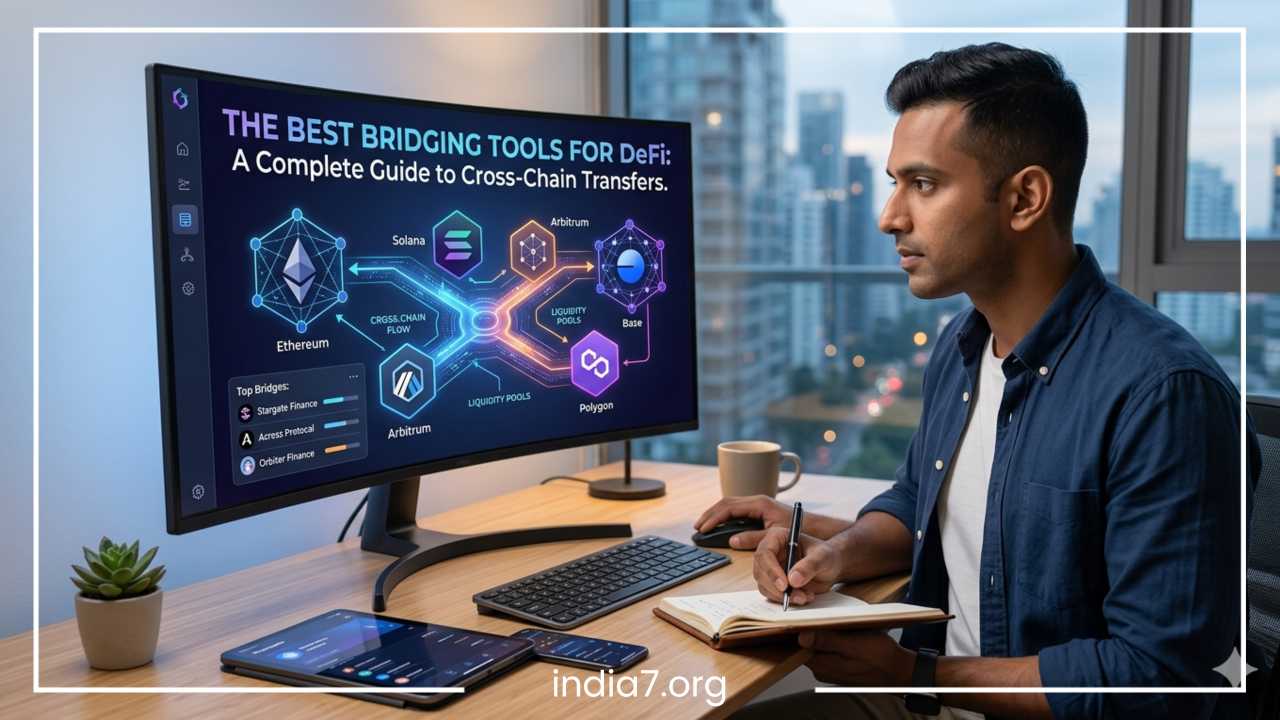
Best Cross-Chain Bridging for Stablecoins

Best Cross-Chain Bridging for Stablecoins: Top Solutions Compared
The decentralized finance landscape has grown from an experimental ecosystem into a multi-billion dollar financial market, with stablecoins serving as its bedrock. Stablecoins provide the pricing stability required for predictable trading, lending, borrowing, and payments. However, as the number of layer-1 networks and layer-2 scaling solutions has multiplied, liquidity has become fragmented across isolated ecosystems. This fragmentation has made a robust cross-chain bridge for stablecoins an essential piece of infrastructure for any crypto participant.
Users frequently need to move stablecoins across chains to optimize their financial positioning. Capital is constantly flowing between networks to capture the best economic opportunities. The primary use cases driving this cross-chain movement include:
-
Yield farming: Shifting capital to alternative networks offering higher decentralized finance interest rates, liquidity mining rewards, or incentive programs.
-
Cross-chain trading: Executing token swaps on decentralized exchanges located on target networks to acquire chain-specific assets.
-
Payments: Settling peer-to-peer or commercial transactions on networks optimized for speed and low cost.
-
Liquidity migration: Moving large reserves of capital to deep liquidity pools on newly launched protocols to minimize trading slippage.
While moving stablecoins from one ledger to another unlocks substantial capital efficiency, the process introduces unique technical trade-offs. Security concerns remain central to these operations. Because bridges act as massive honey pots holding locked capital, choosing a secure and optimized stablecoin bridge requires an understanding of how these protocols function beneath the surface.
Read: Refused House Insurance Claim? – Find Out Why
What Is Cross-Chain Bridging?
A blockchain bridge is a protocol that allows two or more distinct blockchain networks to exchange data and assets. At their core, blockchains are designed to operate as isolated, self-contained ledgers. An Ethereum smart contract cannot natively read or write to the Solana ledger, nor can an Arbitrum execution environment interact directly with the BNB Chain without an intermediary layer. Bridges solve this interoperability problem by creating communication pathways between these separate ecosystems.
When a user transfers an asset like Tether or USD Coin through a stablecoin bridge, the asset does not physically travel across space. Instead, the bridge facilitates a coordinated state change across both networks. The mechanics used to achieve this state change vary by protocol design, but they generally fall into three primary architectural categories.
Lock-and-Mint Bridges
In a lock-and-mint architecture, the bridge protocol manages a repository or smart contract on the source chain. When a user wants to bridge USDT from Ethereum to another chain, the original tokens are deposited and locked securely within the Ethereum smart contract. Once the bridge infrastructure verifies this deposit, it signals a smart contract on the destination chain to mint an equivalent amount of wrapped tokens. A common example is taking native USDC on Ethereum and generating a wrapped, bridged version of USDC on a non-native alternative chain. If the user wants their original tokens back, the wrapped assets must be sent back to the destination contract to be destroyed, unlocking the native assets on the source chain.
Burn-and-Mint Bridges
Burn-and-mint architectures eliminate the need for an asset repository on the source chain. Instead of locking tokens, the protocol completely destroys the native assets on the source chain when a transfer is initiated. The bridge verifies this destruction via cryptographic proofs and signals the destination chain to mint brand-new, native tokens for the user. This approach prevents systemic risks associated with large pools of locked capital and ensures that the total circulating supply across all networks remains perfectly balanced.
Liquidity-Based Bridges
Liquidity-based architectures rely on pre-funded liquidity pools established on both the source and destination networks. Instead of minting new tokens or creating wrapped derivatives, the user deposits native stablecoins into a pool on the source chain and draws native stablecoins out of a corresponding pool on the destination chain. The total supply of the asset remains unchanged, and the user receives clean, un-wrapped tokens. The bridge protocol manages the rebalancing of these pools behind the scenes, using various rebalancing models or algorithmic incentives to ensure neither side runs out of inventory.
To execute a standard cross-chain stablecoin transfer, a user connects their web3 wallet to a bridge interface, selects the source chain and destination chain, and authorizes the transaction. The source smart contract processes the input, a validation layer relays the proof of deposit, and the destination smart contract releases the funds directly to the user’s wallet on the target network.
Read: Protecting Everything You Own With Home Contents Insurance
Why Stablecoin Bridging Matters
Stablecoin bridging is the financial glue that holds multi-chain decentralized finance together. Without the ability to move stable assets fluidly, the web3 economy would stall, and capital would remain locked within expensive or congested environments.
Access Better Yields
Yield opportunities change rapidly across the decentralized finance sector. A lending pool on an emerging layer-2 network might offer high yields due to temporary capital scarcity or protocol incentive rewards, while the same pool on Ethereum might yield low returns. By utilizing a bridge USDT or bridge USDC pathway, capital allocators can shift idle stablecoins to high-performing pools within minutes, maximizing their compounding returns.
Lower Transaction Costs
Operating directly on the Ethereum mainnet can become cost-prohibitive for retail users during periods of high network congestion. By bridging stablecoins away from Ethereum and onto layer-2 scaling solutions like Arbitrum or Base, transaction costs drop dramatically. This cost reduction allows users to execute micro-transactions, deploy complex yield-generating strategies, and interact with smart contracts for fractions of a penny rather than tens of dollars.
Faster Transactions
Alternative layers and specialized networks process transactions with much faster block times and shorter finality periods than legacy base layers. Bridging stablecoins to these optimized environments allows users to experience instantaneous confirmations, which is vital for real-time commerce, gaming applications, and fast-paced trading environments.
Cross-Chain Arbitrage Opportunities
Asset prices often diverge slightly across different decentralized exchanges and networks due to localized supply and demand imbalances. Arbitrageurs rely on fast, reliable stablecoin bridges to move capital into underpriced markets, purchase assets, and sell them in overpriced markets. This continuous cross-chain rebalancing helps align global crypto market prices and deepens liquidity across all participating networks.
Multi-Chain Treasury Management
Decentralized autonomous organizations, web3 projects, and institutional asset managers distribute their digital asset reserves across multiple blockchain networks to mitigate systemic risks and fund multi-chain operations. Efficient bridging infrastructure enables these organizations to rebalance their treasuries, pay global contributors in real-time, and fund operational expenses across diverse ecosystems without liquidating their core holdings.
Read: How You Can Get Rid of Student Loan Debt in Chapter 7 Bankruptcy
Key Factors to Evaluate a Stablecoin Bridge
Not all bridges are engineered equally. When choosing a protocol to move high-value stablecoin assets, users must evaluate several operational vectors to ensure they are balancing speed, cost, and safety effectively.
Security
Security is the single most critical factor when evaluating a bridge. Users must investigate whether the protocol has undergone multiple reputable third-party smart contract audits. Beyond audits, the structural validator design dictates safety. Is the bridge secured by a centralized multi-signature wallet, a decentralized network of independent validators, or trustless cryptographic proofs? Reviewing the platform’s historical track record regarding smart contract vulnerabilities and exploits provides crucial insight into its architectural resilience.
Supported Stablecoins
A versatile bridge must support the specific stablecoin assets required for a user’s target strategies. While universal coverage for primary assets like USDC and USDT is standard, coverage for other prominent stablecoins like DAI, FDUSD, or PYUSD varies significantly between protocols. High-quality bridges ensure that these assets can be moved without forced conversions or undesirable asset wrapping.
Supported Networks
The utility of a bridge is directly tied to its network connectivity. An optimal cross-chain bridge for stablecoins should bridge gaps between major ecosystems, including:
-
EVM Layer-1s: Ethereum and BNB Chain
-
EVM Layer-2s: Arbitrum, Base, Polygon, and Avalanche
-
Non-EVM Networks: High-throughput environments like Solana
Fees
Bridges monetize their services and cover network gas costs through varying fee structures. These expenses generally include gas fees to execute transactions on both the source and destination chains, alongside protocol service fees. Some platforms charge a flat transaction rate, while others assess a percentage-based fee proportional to the total volume transferred. For large transactions, percentage fees can become expensive, whereas flat fees may be disadvantageous for smaller retail transfers.
Speed
The time required for funds to arrive on the destination chain can range from seconds to hours. Speed depends heavily on the underlying consensus mechanisms of the networks involved, the security design of the bridge, and the number of block confirmations required to guarantee transaction finality. Fast bridging is highly desirable, but speed must never come at the expense of proper transaction validation.
Liquidity Depth
Deep liquidity pools prevent excessive slippage and ensure transfers are completed successfully. If a bridge lacks deep stablecoin liquidity on the destination network, large transfers can get delayed, or users may receive less capital than anticipated due to high slippage penalties. Choosing platforms with high Total Value Locked ensures smoother execution.
User Experience
A convoluted interface can lead to costly user errors, such as sending funds to incompatible addresses or choosing wrong asset variants. The ideal bridge provides an intuitive, clean interface, clear fee breakdowns before execution, real-time transaction tracking, and native integrations with popular software and hardware wallets.
Best Cross-Chain Bridges for Stablecoins
Evaluating individual bridging solutions reveals how specific protocols optimize for different user needs, technical architectures, and network ecosystems.
Stargate Finance
Stargate Finance is a prominent liquidity-based bridge built on top of LayerZero’s cross-chain messaging infrastructure. It solved the long-standing “bridging trilemma” by combining instant guaranteed finality, unified liquidity, and native asset transfers into a single architecture.
-
Supported Chains: Ethereum, Arbitrum, Optimism, Base, BNB Chain, Avalanche, Polygon, and several emerging rollups.
-
Strengths: Stargate utilizes a unified liquidity model that allows all connected chains to draw from a single pool of capital, drastically reducing slippage. Transfers consist of pure, native stablecoins, eliminating any reliance on risky wrapped token variants.
-
Weaknesses: Because it relies on deep liquidity pools, rebalancing fees can increase during periods of high one-way transactional volume.
-
Best For: Institutional participants and DeFi users looking to execute large stablecoin transfers safely without wrapped asset risk.
Across Protocol
Across Protocol is an intent-based bridging network designed specifically for speed and capital efficiency. Instead of forcing transactions through slower, traditional validation layers, Across utilizes a network of independent liquidity providers called “Relayers” who fulfill user intents immediately using their own capital.
-
Supported Chains: Main focus on Ethereum and leading layer-2 networks including Arbitrum, Optimism, Base, and Polygon.
-
Strengths: Unmatched transactional speed and low fee structures. Relayers take on the short-term settlement risk in exchange for a small fee, allowing users to receive their destination stablecoins almost instantly. The design is incredibly capital-efficient, leading to low structural overhead.
-
Weaknesses: Ecosystem routing is primarily optimized for Ethereum and its layer-2 scaling ecosystems, offering less coverage for distinct non-EVM environments.
-
Best For: Everyday DeFi users who prioritize transaction speed and minimal fee expenditure when moving funds across layer-2 chains.
Circle CCTP
The Cross-Chain Transfer Protocol (CCTP) is an infrastructure stack developed natively by Circle, the official issuer of USDC. It represents a highly secure approach to stablecoin interoperability by utilizing an official burn-and-mint mechanism.
-
Supported Chains: Ethereum, Solana, Arbitrum, Optimism, Base, Avalanche, Polygon, and BNB Chain.
-
Strengths: CCTP offers absolute zero slippage because it does not rely on static liquidity pools. When a user bridges USDC, the source tokens are permanently burned, and Circle’s native infrastructure mints identical, official USDC on the destination network. This design completely eliminates wrapped token risks and platform liquidity constraints.
-
Weaknesses: The protocol only supports USDC transfers. Additionally, transaction speeds are tied directly to the native finality requirements of the participating chains, making it slower than intent-based solutions during peak congestion.
-
Best For: Dedicated USDC users who prioritize absolute architectural security and zero slippage over multi-asset flexibility.
Wormhole
Wormhole is a foundational decentralized cross-chain messaging protocol that connects disparate ecosystem architectures. It functions as an interoperability layer capable of transferring tokens and generic data across entirely different state machines.
-
Supported Chains: Extensive coverage across more than 30 networks, including deep connectivity between Ethereum, Solana, Sui, Aptos, and major EVM environments.
-
Strengths: Wormhole serves as a primary gateway for bridging assets into high-throughput, non-EVM networks like Solana. It handles high transactional volumes and enjoys broad institutional backing and deep protocol integrations.
-
Weaknesses: The interface and underlying wrapped asset mechanics can feel overly complex to novice users. Historically, its large-scale architecture has made it a visible target for sophisticated security exploits.
-
Best For: Solana users and multi-chain ecosystem participants needing to bridge stablecoins outside standard EVM boundaries.
Synapse Protocol
Synapse Protocol is an interoperability network that combines cross-chain messaging with automated market maker liquidity pools. It allows users to simultaneously bridge and swap assets across different networks in a single transaction.
-
Supported Chains: Broad coverage across Ethereum, Arbitrum, Optimism, Base, BNB Chain, Avalanche, Polygon, and numerous niche layer-2 or application-specific chains.
-
Strengths: Excellent multi-chain asset routing capabilities. If a destination network lacks a specific stablecoin pool, Synapse can automatically swap incoming funds into the native local stablecoin variant during the bridging process.
-
Weaknesses: The multi-step swap-and-bridge process can incur higher total gas costs and slight slippage compared to pure native transfer protocols.
-
Best For: Exploratory users seeking broad ecosystem coverage and integrated cross-chain stablecoin swapping functionality.
deBridge
deBridge is a high-performance cross-chain interoperability protocol that enables decentralized transfers of data and assets. Through its specialized cross-chain trading infrastructure, deBridge focuses on speed, direct routing, and deep liquidity execution.
-
Supported Chains: Ethereum, Solana, Arbitrum, Optimism, Base, BNB Chain, and Avalanche.
-
Strengths: Extremely fast execution times coupled with high security parameters. It utilizes a zero-locked-liquidity architecture for its trading infrastructure, meaning user funds are never left sitting in vulnerable smart contracts where they could be exposed to exploits.
-
Weaknesses: The professional-grade interface and emphasis on complex order routing may present a steeper learning curve for casual retail users.
-
Best For: Advanced users, algorithmic traders, and whales who require rapid execution and minimal slippage across major EVM networks and Solana.
Comparison Table
The following matrix summarizes the core features, operational capabilities, and specific use cases for each of the top stablecoin bridging networks:
| Bridge | Stablecoins | Chains | Speed | Fees | Best For |
| Stargate Finance | USDC, USDT, DAI | Ethereum, L2s, BNB Chain | Moderate (2-5 mins) | Variable (Pool-dependent) | Large stablecoin transfers |
| Across Protocol | USDC, USDT | Ethereum, Major L2s | Very Fast (Sub-minute) | Very Low | Everyday DeFi users |
| Circle CCTP | USDC Only | Ethereum, Solana, L2s | Moderate (Network-dependent) | Low (Gas only) | USDC users |
| Wormhole | USDC, USDT, Multi-asset | Ethereum, Solana, Sui, L2s | Moderate (3-10 mins) | Low | Solana users |
| Synapse Protocol | USDC, USDT, DAI | Extensive EVM & L2 networks | Moderate (3-5 mins) | Variable (Swap-dependent) | Broad ecosystem coverage |
| deBridge | USDC, USDT | Ethereum, Solana, L2s | Fast (1-2 mins) | Low | Advanced users |
Security Risks of Stablecoin Bridging
Cross-chain bridges represent some of the most complex infrastructure in the blockchain industry. Because they manage billions of dollars in shifting digital asset values, they are frequent targets for highly sophisticated cyberattacks. Understanding these architectural vulnerabilities is critical for managing capital risk.
Smart Contract Vulnerabilities
Bridges rely on extensive, highly complex smart contract code bases to manage locks, mints, burns, and redemptions across different programming languages and runtime environments. Any oversight, coding error, or logic flaw within these contracts can be exploited by malicious actors to drain the underlying funds completely.
Validator Risks
Many cross-chain protocols rely on an intermediary set of validators, or a multi-signature node network, to verify that a transaction occurred on the source chain before authorizing fund releases on the destination chain. If a majority of these validators become compromised, collude maliciously, or suffer private key leaks, they can authorize fraudulent transfers and completely deplete the bridge reserves.
Liquidity Risks
Liquidity-based bridges require constant asset balancing across all participating networks. During major market dislocations or black swan events, massive capital flights can occur in a single direction. If the liquidity pools on a destination chain become entirely depleted, user transfers can become stuck in limbo for hours or days until the protocol rebalances the capital distribution.
Wrapped Asset Risks
When utilizing bridges that output wrapped asset variants instead of native stablecoins, users assume structural dependency risk. If a lock-and-mint bridge suffers an exploit on its source Ethereum repository, the wrapped stablecoins circulating on the secondary network instantly lose their collateral backing, rendering them entirely worthless.
Bridge Hacks
The crypto industry has witnessed several historic security breaches highlighting these structural vulnerabilities:
-
The Ronin Bridge Hack: A catastrophic exploit where attackers gained control of five out of nine validator private keys, resulting in a loss of over six hundred million dollars.
-
The Wormhole Exploit: A smart contract validation flaw that allowed an attacker to bypass signature verification and mint over three hundred million dollars worth of unbacked wrapped Ether on Solana.
-
The Nomad Bridge Hack: A configuration flaw introduced during a routine smart contract update allowed users to copy-paste valid transaction data and systematically drain nearly two hundred million dollars from the pool.
These events have forced the industry to move away from centralized validator structures and wrapped asset designs, favoring native burn-and-mint architectures and intent-based routing models.
Best Bridge by Use Case
To simplify the selection process, specific platforms can be categorized by their primary operational strengths and structural advantages.
Best Overall: Stargate Finance
Stargate Finance offers a well-balanced combination of safety, chain coverage, and native asset guarantees. By avoiding wrapped token architectures and utilizing LayerZero’s messaging infrastructure, it remains a reliable option for general multi-chain stablecoin bridging.
Fastest: Across Protocol
Across Protocol consistently outpaces traditional bridges by using its intent-based architecture. Because realayers fill orders immediately using their personal liquidity on the destination network, users rarely have to wait for slow base-layer block confirmations to complete their transfers.
Best for USDC: Circle CCTP
When moving USDC, using the issuer’s native protocol is highly advantageous. Circle CCTP removes intermediary smart contract pool risks by systematically burning and minting official tokens, ensuring zero slippage and clean asset issuance.
Best for Solana: Wormhole
Wormhole provides deep, battle-tested routing infrastructure connecting legacy EVM chains directly with Solana’s non-EVM execution environment, making it a critical portal for ecosystem diversification.
Best for Large Transfers: Stargate Finance
The unified liquidity design used by Stargate ensures that institutional allocators moving high-volume stablecoin blocks can access deep pools, reducing price distortions and structural execution risks.
Best for Advanced Traders: deBridge
The zero-locked-liquidity architecture and sophisticated order execution parameters found within deBridge make it well-suited for professional market participants who require fast, secure routing without contract-exposure overhead.
Future of Stablecoin Bridging
The cross-chain landscape is undergoing a structural paradigm shift aimed at eliminating user friction and security vulnerabilities. One of the most significant advancements is the rise of intent-based bridging and chain abstraction. Instead of forcing users to manually select bridges, calculate destination gas fees, and understand underlying mechanics, modern protocols allow users to state their final goal. The underlying infrastructure then automatically coordinates the optimal routing, execution, and fee management behind a seamless user interface.
Furthermore, native stablecoin issuance is rapidly outpacing the use of wrapped token variations. Major stablecoin issuers are expanding their native presence across alternative layer-2 networks, allowing technologies like Circle’s CCTP to handle transactions directly. This trend drastically reduces the attack surface of decentralized finance by reducing the industry’s reliance on vulnerable, long-term locked asset repositories.
As interoperability protocols become more modular and integrated directly into decentralized applications, stablecoin bridging will eventually become a completely background process. Users will interact with multi-chain applications seamlessly, while automated cross-chain liquidity networks handle asset routing invisibly in the stablecoin layer.
Final Thoughts
There is no singular, universal bridging solution that fits every crypto participant perfectly. Choosing the correct platform requires a clear understanding of your personal priorities for a given transaction. If transaction velocity and minimal fees are your main focus, intent-based networks like Across Protocol provide an exceptional experience. If you are moving high volumes of USDC and prioritize long-term asset security above all else, utilizing Circle’s native CCTP architecture removes structural intermediary risks.
Security considerations should always take priority over speed or marginal fee savings. When navigating the multi-chain ecosystem, look to execute native stablecoin transfers whenever possible, minimize exposure to wrapped assets, and consistently verify that you are interacting with audited, liquid, and well-regarded bridging protocols.
Frequently Asked Questions
What is the safest cross-chain bridge for stablecoins?
The safest bridging mechanism relies on native architecture rather than locked collateral pools. Circle Cross-Chain Transfer Protocol (CCTP) is widely considered the safest option for USD Coin because it completely eliminates wrapped token risks. It utilizes an official burn-and-mint infrastructure to destroy tokens on the source chain and recreate them natively on the destination chain. For multi-asset transfers involving Tether, decentralized protocols that do not lock permanent liquidity honeypots, such as intent-based models like Across Protocol or zero-locked liquidity engines like deBridge, present significantly fewer structural attack surfaces compared to traditional multi-signature lock-and-mint bridges.
How do I bridge USDT from Ethereum to Solana with low fees?
To move Tether from Ethereum to Solana without incurring high mainnet gas fees, specialized cross-chain messaging routes like Wormhole or liquidity routers like deBridge are ideal choices. The general step-by-step transfer workflow involves:
-
Connect an EVM-compatible wallet containing your Ethereum USDT alongside enough native Ether to cover the initial transaction gas.
-
Connect a Solana-native software wallet to act as the destination address.
-
Input the exact amount of Tether you intend to transfer and evaluate the network fee breakdown.
-
Approve the token allowance contract and authorize the cross-chain transaction. Your funds will settle natively into your target destination wallet once network finality is achieved.
Why is my bridged USDC or USDT showing up as a wrapped token?
If your bridged assets appear under alternative ticker symbols like USDC.e or anyUSDT, you have utilized a traditional lock-and-mint bridge rather than a native routing mechanism. This occurs when a protocol locks native assets inside a repository on the source chain and issues a synthetic wrapped placeholder token on the destination chain. To avoid wrapped token variants and eliminate secondary smart contract exposure, select platforms that explicitly guarantee native-to-native asset routing via pre-funded liquidity pools or official burn-and-mint infrastructure.
What is the fastest way to bridge stablecoins between layer-2 networks?
Intent-based cross-chain bridges offer the fastest transaction settlement times when moving stablecoins across layer-2 execution environments like Arbitrum, Base, Optimism, and Polygon. Platforms like Across Protocol leverage independent liquidity providers who instantly fill your order out of their personal localized funds on the destination chain, bypassing the slow verification timelines of canonical base layer blocks. These intent-driven transactions typically achieve full settlement inside your target wallet within five to fifteen seconds.
Can I lose my stablecoins if a cross-chain bridge gets hacked?
Your capital is exposed to varying degrees of risk depending on the specific bridge architecture you choose:
-
High Risk: If you hold wrapped stablecoins generated by a lock-and-mint bridge and that bridge’s source contract repository is compromised or drained, your wrapped tokens instantly lose their collateral backing and can de-peg to zero value.
-
Transient Risk: If you use an automated market maker or a liquidity-pool bridge, your funds are only exposed during the brief transactional window while your swap is actively processing inside the contract.
-
Low Risk: Using official infrastructure like Circle CCTP protects your funds from systemic bridge hacks because no permanent shared liquidity repositories exist for attackers to exploit.