Top Ways to Stay Focused When Working from Home
Top Ways to Stay Focused When Working from Home: Boost Productivity and Minimize Distractions
The landscape of the modern professional world has undergone a seismic shift. Remote work, once a luxury or a niche arrangement for freelancers, has become a standard operating model for millions. While the transition away from long commutes and rigid office hierarchies offers unprecedented freedom, it has introduced a new set of complex challenges. Working from home is a double-edged sword; the very environment that provides comfort and flexibility can also become a minefield of distractions, leading to fragmented focus and, eventually, professional burnout.
Maintaining concentration in a space designed for relaxation is not an innate skill; it is a discipline that must be cultivated. When your “office” is also your kitchen, your living room, or your bedroom, the psychological boundaries that once governed our productivity begin to blur. This lack of structure can lead to a paradox where we feel like we are working all the time, yet accomplishing very little.
Read: 7 Ideas on Making Business Blogging More Efficient
Focus is the currency of the modern economy. It is the primary driver of high-quality output and, perhaps more importantly, a safeguard for our mental well-being. By mastering the art of deep work within a home environment, you can reclaim your time, reduce stress, and ensure that your professional life doesn’t bleed into your personal peace. This article provides a comprehensive roadmap to optimizing your home-based productivity through environmental changes, psychological shifts, and proven time-management strategies.
Read: Live Business Blogging: Captivate Your Audience
Why It’s Hard to Stay Focused at Home
To solve the problem of distraction, we must first understand the fundamental differences between the office and the home environment. In a traditional office, the architecture itself reinforces work behavior. You are surrounded by colleagues performing similar tasks, there is a clear “boss” presence—even if they aren’t looking over your shoulder—and the professional decorum naturally discourages domestic impulses.
At home, these external pressures vanish. The psychological factor of “comfort” is a major hurdle. When you are sitting on the same couch where you watch movies, your brain struggles to transition into a high-alert professional state. Furthermore, the lack of immediate supervision can lead to a “procrastination loop.” Without the social accountability of an office, it is much easier to justify “just five minutes” on a non-work task.
The distractions at home are uniquely personal and persistent:
-
Social Media: With no one to see your screen, the temptation to check feeds becomes a constant itch.
-
Household Chores: The pile of laundry or the dirty dishes in the sink act as visual “open loops” that pull your attention away from complex cognitive tasks.
-
Family and Roommates: Unlike colleagues who understand the flow of a workday, family members may view your presence as an invitation for conversation or assistance with domestic needs.
Without a rigid routine and clear physical boundaries, the brain remains in a state of “low-level multi-tasking,” never quite fully at work and never quite fully at rest.
Read: The Ultimate Guide to Business Blogging: Attract, Engage, Convert
Create a Dedicated Workspace
The first step in reclaiming your focus is to establish a physical boundary between your life and your labor. The importance of a dedicated workspace cannot be overstated; it serves as a powerful psychological trigger. When you enter this space, your brain receives the signal that it is time to work. When you leave, you are effectively “clocking out.”
Choose a Quiet, Clutter-Free Area
Ideally, your workspace should be a separate room with a door that closes. If that isn’t possible, choose a specific corner of a room that is away from high-traffic areas like the kitchen or the front door. Clutter is a silent productivity killer; a messy desk leads to a messy mind. Keep your surface clear of everything except the tools necessary for your immediate task.
Ergonomic Setup
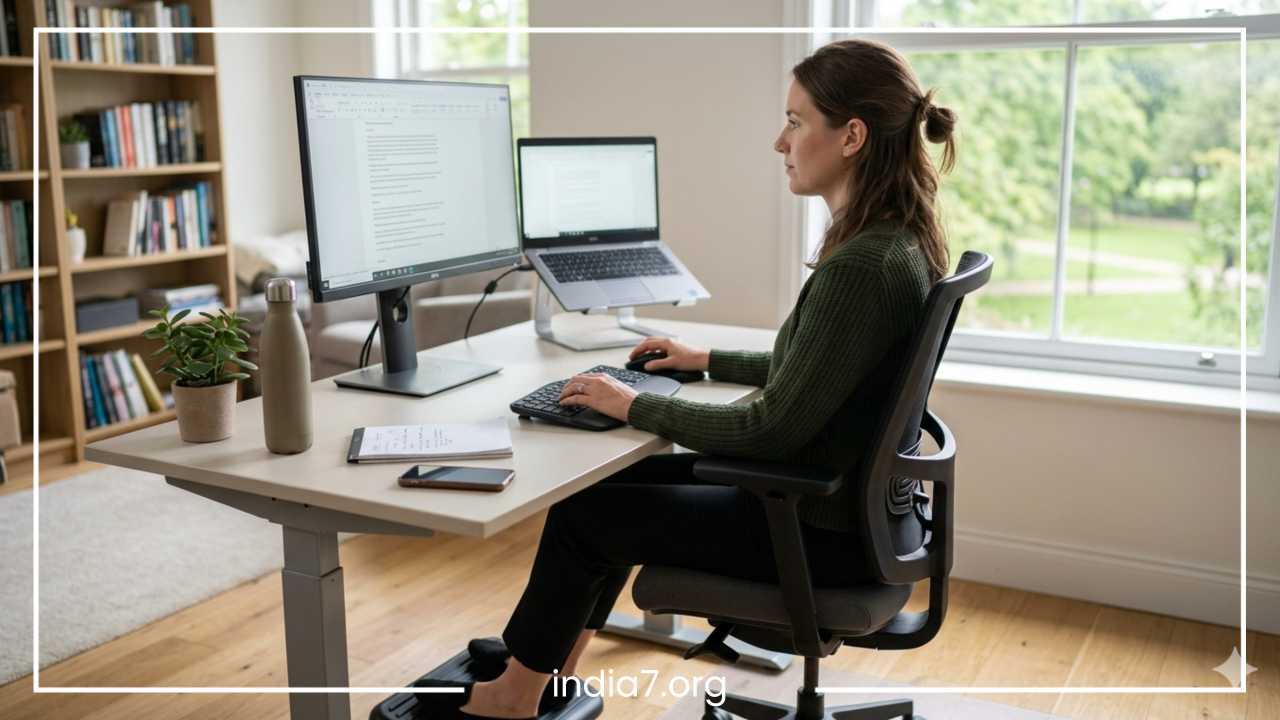
You cannot maintain deep focus if you are in physical pain. Investing in a high-quality ergonomic chair that supports your lower back is essential. Your desk should be at a height where your elbows are at a 90-degree angle, and your monitor should be at eye level to prevent neck strain. Proper lighting is equally vital; natural light is best for maintaining energy levels, but if that isn’t available, ensure you have warm, non-flickering artificial light to reduce eye fatigue.
Small Space Solutions
If you live in a small apartment or a shared home, you can still create a “zone.” Use a room divider, a tall bookshelf, or even a rug to visually define the work area. If you must use your dining table, use a specific desk mat or a particular lamp that you only turn on during work hours. These small sensory cues help bridge the gap between a multipurpose room and a professional station.
Stick to a Consistent Daily Routine
Human beings are creatures of habit. Our brains are designed to conserve energy by automating repetitive behaviors. When you work from home, the lack of a commute removes a natural “buffer” that prepares the mind for the day. To compensate, you must create an intentional routine that mimics the structure of a traditional workday.
Set Fixed Start and End Times
One of the biggest traps of remote work is “work creep,” where you start answering emails as soon as you wake up and continue until you go to bed. Set a firm start time and a firm “hard stop” time. This creates a sense of urgency during the day, as you know your time is limited, and it ensures you actually recover in the evening.
Morning Rituals
Develop a sequence of actions that signal the start of the workday. This could include making a fresh pot of coffee, a ten-minute stretching routine, or even a “fake commute” where you walk around the block before sitting at your desk. These rituals help shift your mental gears from “home mode” to “productivity mode.”
Scheduling Breaks and Consistency
Don’t wait until you are exhausted to take a break. Schedule them into your calendar. Consistency is key here; by performing the same actions at the same time every day, you reduce “decision fatigue.” You no longer have to wonder when you will eat or when you will finish; the schedule decides for you, leaving your mental energy free for your actual work.
Use Time Management Techniques
Working for eight hours straight is an impossible goal for the human brain. We operate in cycles of high and low energy. To maximize your output, you need to use time management frameworks that align with how your brain actually functions.
The Pomodoro Technique
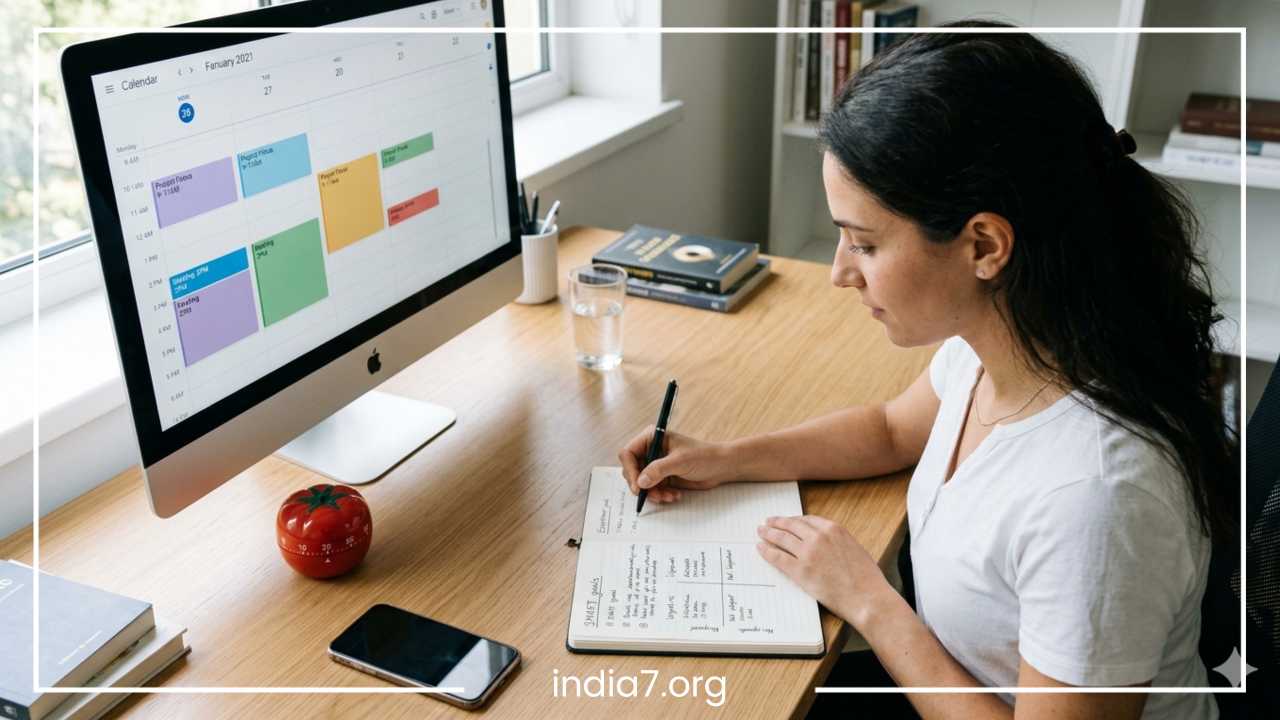
This is perhaps the most famous method for focus. You work for 25 minutes (a “Pomodoro”) and then take a 5-minute break. After four cycles, you take a longer break of 15 to 30 minutes. This technique is effective because it makes the work feel manageable and provides frequent “rewards” in the form of breaks, preventing the feeling of being overwhelmed.
Time Blocking and Task Batching
Instead of working from a chaotic to-do list, use time blocking. Assign specific blocks of time in your calendar to specific tasks (e.g., 9:00 AM to 10:30 AM for “Report Writing”). Pair this with task batching—grouping similar small tasks together. For example, instead of checking email every ten minutes, batch all communication into two 30-minute windows per day. This prevents “context switching,” which is the mental drain caused by jumping between different types of tasks.
Prioritization Methods
-
Eisenhower Matrix: Categorize tasks into four quadrants: Urgent and Important, Important but Not Urgent, Urgent but Not Important, and Neither. Focus your energy on the “Important but Not Urgent” quadrant to prevent future crises.
-
80/20 Rule (Pareto Principle): Identify the 20 percent of your tasks that produce 80 percent of your results. Prioritize these tasks during your peak energy hours.
Minimize Digital Distractions
In a remote setting, your computer is both your greatest tool and your greatest distraction. Without the physical presence of a supervisor, the digital “rabbit hole” is only a click away. To stay focused, you must build digital fences around your attention.
Notification Management
Notifications are designed to hijack your dopamine system. Turn off all non-essential notifications on both your computer and your phone. This includes social media alerts, news updates, and even some internal chat notifications. If a task requires deep concentration, put your phone in another room or use “Do Not Disturb” mode.
Focus Apps and Website Blockers
If willpower isn’t enough, use technology to fight technology. Tools like “Cold Turkey” or “Freedom” can block specific distracting websites (YouTube, Reddit, news sites) during your work hours. Some apps even allow you to lock yourself out of the internet entirely for a set period.
Email and “Deep Work” Hours
Email is often a “convenient distraction”—it feels like work, but it usually isn’t your most important task. Set specific hours for “Deep Work” where you close your browser tabs, shut down your email client, and focus entirely on a single complex project. Let your team know that you are “offline” during these windows to ensure you aren’t interrupted by “urgent” but ultimately minor requests.
Set Clear Goals and Daily Tasks
Vague goals lead to vague efforts. If you sit down at your desk with a general idea that you need to “be productive,” you will likely waste the first hour deciding what to do. Clarity is the antidote to procrastination.
Break Big Tasks into Smaller Steps
A project like “Launch New Website” is too large to tackle in one go. It feels daunting, which triggers the brain’s avoidance response. Break it down into micro-tasks: “Write copy for About page,” “Select five stock images,” “Test contact form.” Small tasks provide frequent “wins,” which builds the momentum necessary to keep going.
The Daily To-Do List and Productivity Tools
At the start of each day (or the night before), list the three most important things you must accomplish. Use tools like Trello, Notion, or Asana to track your progress. These platforms allow you to visualize your workflow and keep all related files and notes in one place, reducing the time spent hunting for information.
The End-of-Day Review
Spend the last ten minutes of your workday reviewing what you accomplished. This provides a sense of closure and allows you to “download” your remaining tasks onto a list for tomorrow. This habit prevents “Zeigarnik Effect”—the tendency to keep thinking about unfinished tasks—allowing you to fully relax during your off-hours.
Take Regular Breaks
It may seem counterintuitive, but the key to working more is often working less. Continuous cognitive effort leads to “decision fatigue” and a decline in the quality of your work. Breaks are not a sign of laziness; they are a biological necessity for sustained performance.
Why Breaks Improve Focus
When you focus intensely on a task, your brain eventually loses its “sensitivity” to that task, much like how you stop noticing a specific smell after being in a room for a while. Taking a brief diversion forces your brain to “re-activate,” allowing you to return to the task with a fresh perspective and renewed energy.
Types of Breaks
-
Short Breaks (5–10 minutes): These should be taken every hour. Use them to stretch, refill your water, or look out a window to rest your eyes.
-
Longer Breaks (30–60 minutes): Your lunch break should be a complete departure from work. Leave your desk. If possible, go outside for a walk. The movement and change of scenery help lower cortisol levels and stimulate creative thinking.
Avoid Screen-Heavy Breaks
The biggest mistake people make is taking a break from their computer screen by looking at their phone screen. This does not allow your brain to rest. True recovery happens when you engage in “low-arousal” activities: listening to music, tidying a small area, or simply sitting quietly.
Maintain Physical and Mental Well-being
Your brain is a biological organ, and its ability to focus is directly tied to the health of your body. You cannot expect high-level cognitive performance if you are neglected, dehydrated, or sleep-deprived.
Exercise and Movement
Physical activity increases blood flow to the brain and releases endorphins that improve mood and focus. You don’t need a full gym workout; even 20 minutes of brisk walking or yoga can significantly sharpen your mental clarity for the rest of the day.
Diet and Hydration
Heavy, carb-loaded lunches often lead to the “afternoon slump.” Opt for proteins, healthy fats, and complex carbohydrates that provide a steady release of energy. Furthermore, even mild dehydration can cause brain fog and headaches. Keep a large water bottle at your desk and sip it throughout the day.
Sleep and Mindfulness
Sleep is the time when your brain flushes out toxins and consolidates memories. Aim for seven to nine hours of quality sleep. If you find your mind racing during the day, a five-minute mindfulness or meditation session can help “reset” your nervous system. By observing your distracting thoughts without acting on them, you build the “focus muscle” necessary for deep work.
Set Boundaries with Family and Friends
One of the hardest parts of working from home is managing the people around you. Because you are physically present, others may assume you are available for chat, chores, or errands. Without clear boundaries, your focus will be constantly fragmented by “quick questions” and interruptions.
Communicate Your Hours
Be explicit with your family or roommates about when you are working. Share your calendar with them if necessary, so they know when you are in “deep work” mode versus when you are available for a quick chat during a break.
Use Visual Signals
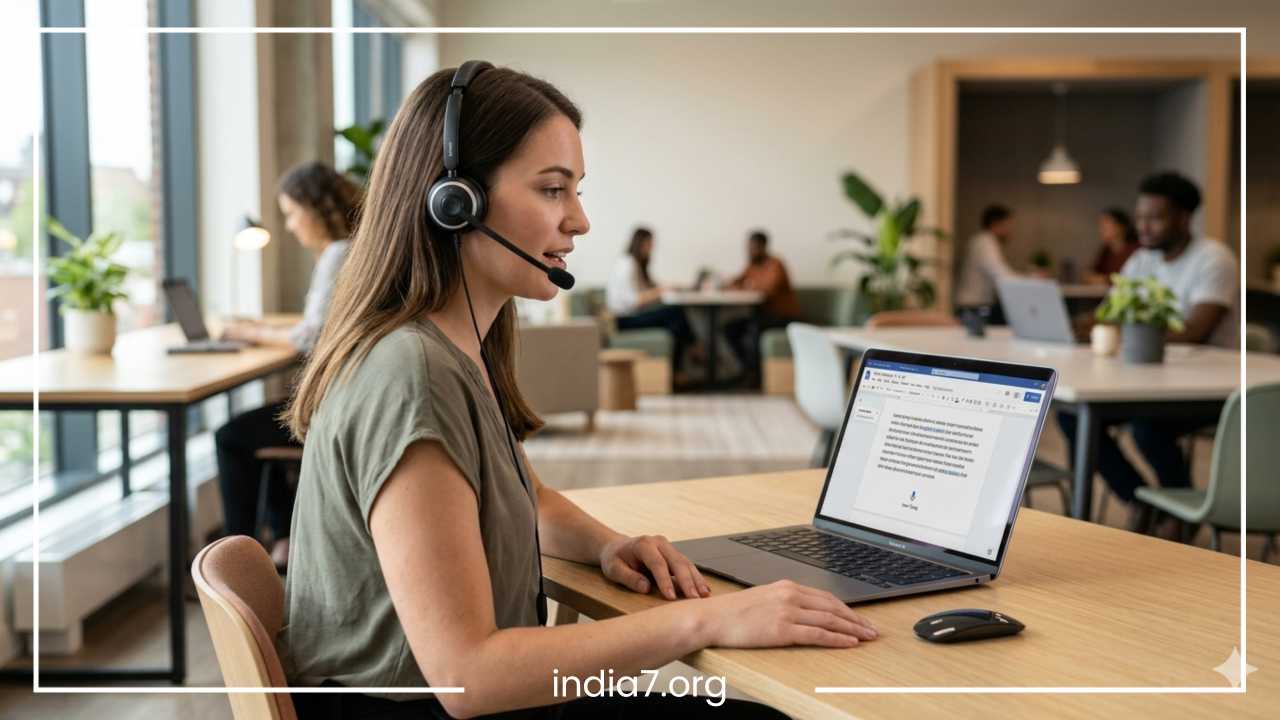
Create a system of non-verbal cues. A closed door is the universal sign for “do not disturb.” If you work in an open area, wearing large over-ear headphones can serve as a signal that you are focusing. Some people even use a “traffic light” system on their desk or door—green for available, red for “in a meeting or deep focus.”
Handling Interruptions Politely
When interrupted, it is important to be firm but kind. Instead of stopping what you are doing, try saying, “I’m right in the middle of something important. Can we talk about this at 12:30 when I take my break?” This trains others to respect your time while reassuring them that their needs will be addressed later.
Dress for Productivity
While the idea of working in pajamas sounds appealing, it can be a significant psychological drain. The way we dress influences how we feel and how we perceive our own authority and competence—a phenomenon known as “enclothed cognition.”
The “Work Mode” Shift
Getting dressed for work creates a mental “on-switch.” It separates the “relaxation self” from the “professional self.” When you remain in the clothes you slept in, your brain stays in a semi-relaxed, sluggish state. You don’t need to wear a suit or formal attire, but changing into “real” clothes (like a pair of jeans and a clean shirt) prepares you for the tasks ahead.
Intentionality Over Formality
The goal isn’t to be uncomfortable; it’s to be intentional. Having a specific “uniform” for work helps reduce decision fatigue in the morning. When the workday ends, changing back into lounge clothes provides a powerful “off-switch,” helping you transition back into your personal life and leave the stresses of the day behind.
Use Music or Background Noise Wisely
The soundscape of your home can either enhance or destroy your focus. Some people thrive in silence, while others find it unsettling. The key is to use sound strategically to drown out unpredictable domestic noises (like neighbors or traffic).
Instrumental vs. Lyrics
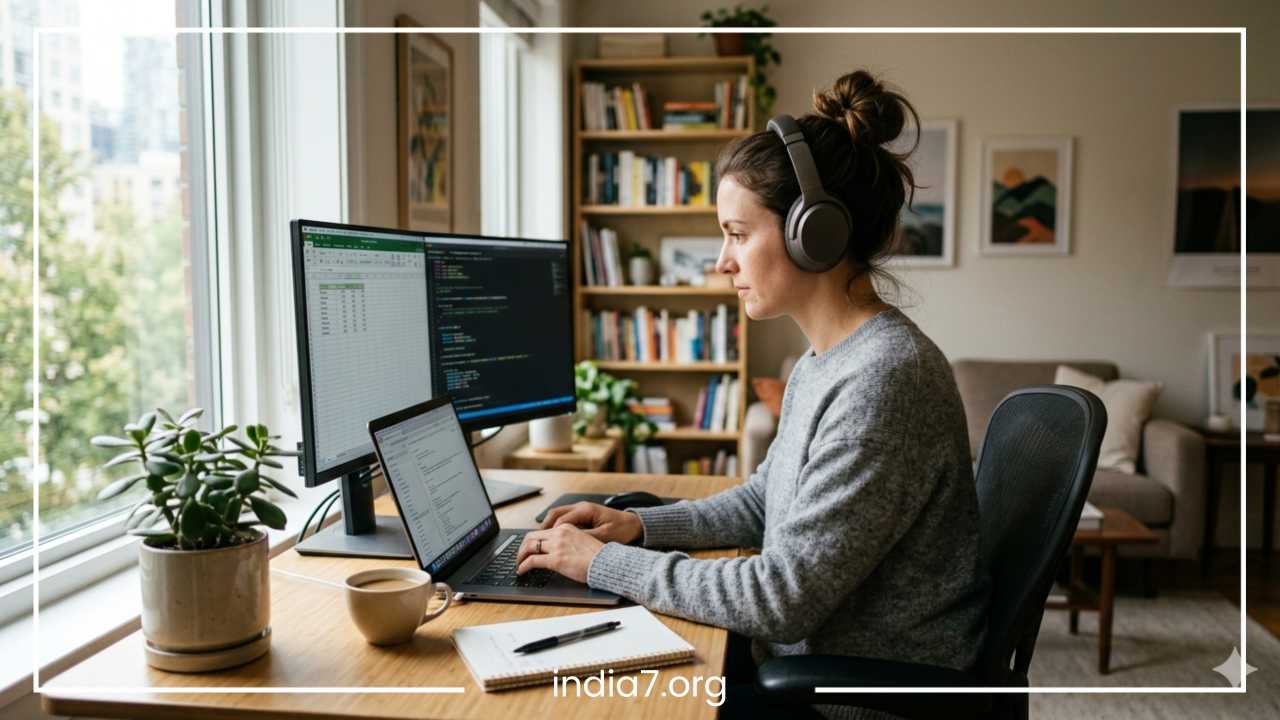
For most people, music with lyrics is distracting because the language-processing part of the brain tries to follow the words, competing with the tasks of writing or reading. For deep focus, instrumental music is generally superior. Classical, lo-fi beats, or ambient electronic music provide a consistent “wall of sound” that helps maintain a flow state.
White Noise and Nature Sounds
If music is too much, white noise or pink noise can be incredibly effective at masking background distractions. Nature sounds—like rainfall, ocean waves, or the steady hum of a coffee shop—can create a soothing environment that promotes concentration without being overwhelming. Experiment with different sounds to see what helps you enter the “zone” the fastest.
Avoid Multitasking
Many people wear “multitasking” as a badge of honor, but scientifically, it is a myth. The human brain cannot focus on two complex tasks at once; instead, it rapidly switches back and forth between them. Each switch incurs a “switching cost,” reducing your overall IQ and increasing the time it takes to finish either task.
The Power of Single-Tasking
Single-tasking—committing to one task until it is finished or until a timer goes off—leads to much higher quality work. You are able to dive deeper into the nuances of a project, leading to more creative solutions and fewer errors.
How to Stop Multitasking
If you feel the urge to switch tasks, it’s often a sign of boredom or difficulty. Instead of giving in, take a “micro-break” of 30 seconds to breathe, then return to the original task. Close all browser tabs that aren’t related to your current project. By focusing on one thing at a time, you actually finish your to-do list faster than if you tried to do everything at once.
Review and Improve Your System
Productivity is not a “set it and forget it” process. It is an ongoing experiment. What works for you one week might not work the next, as your projects and energy levels change. You must become a scientist of your own behavior.
The Weekly Review
Set aside 30 minutes every Friday afternoon to reflect on your week. Ask yourself:
-
When was I most productive?
-
What were my biggest distractions?
-
Which tools or techniques actually helped?
-
What goals did I miss, and why?
Identify and Fix Distractions
If you notice that you consistently get distracted by the same thing—perhaps a certain social media site or a noisy neighbor—create a specific plan to mitigate it. This might mean downloading a more aggressive website blocker or investing in noise-canceling headphones.
Continuous Improvement
Your system should evolve. Don’t be afraid to scrap a technique if it isn’t working for you. The goal isn’t to follow a set of rules perfectly; the goal is to create a bespoke environment and routine that allows you to do your best work.
Final Thoughts
Mastering focus while working from home is a journey of self-awareness and discipline. It requires a combination of physical environmental changes, psychological boundaries, and a commitment to maintaining your own well-being. By creating a dedicated workspace, sticking to a routine, and using smart time-management techniques, you can transform your home into a powerhouse of productivity.
Remember that focus is a skill, not a personality trait. Like any muscle, it becomes stronger with consistent practice. Do not expect perfection from day one; there will be days when the distractions win. The key is to avoid getting discouraged and to return to your system as quickly as possible.
Consistency over time is what leads to significant professional growth and a balanced personal life. You have the tools and the strategies; now it is time to put them into action.